Concrete retaining walls in Berkeley CA - a wall that drains and holds the hill
Is a slope crowding your yard, or is an old wall leaning out? We build poured concrete walls that drain the water and hold the ground.
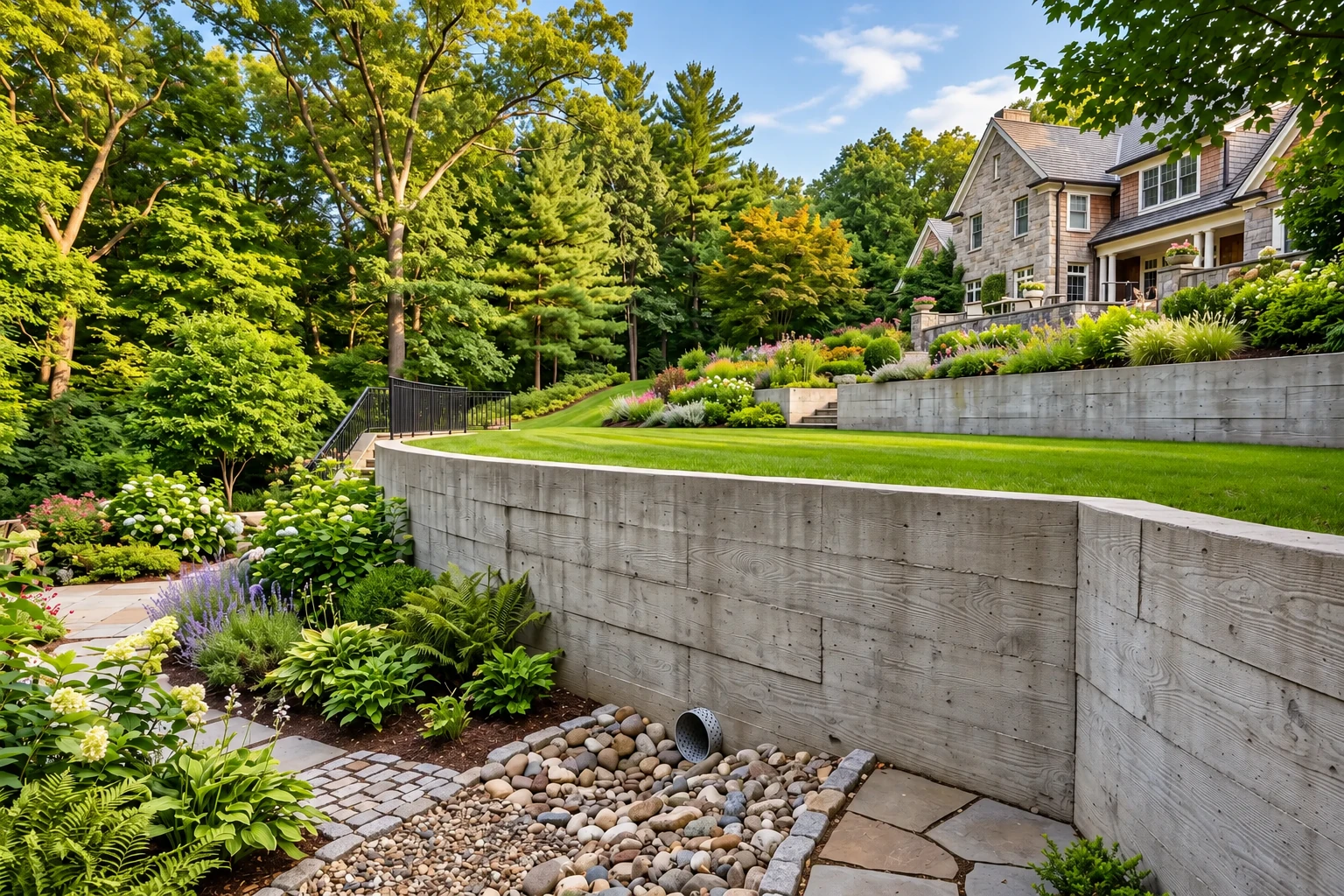
Drainage planned first
Gravel, a drain line and weep holes you can reach.
Reinforced poured concrete
Steel-reinforced walls poured in place and shaped to hold the slope.
Load above checked
We plan around any driveway, building or slope above.
Permits sorted out
We check with the city and handle the paperwork.
Do you need a poured concrete retaining wall?
A concrete retaining wall in Berkeley is a reinforced wall, poured in place and shaped like an L or an upside-down T, that holds back a slope so you get flat, usable ground and a hill that stays put.
Walls fail from water pushing behind them, so drainage is the first thing I plan. Gravel and a drain line go behind the wall. Weep holes, small openings near the base that let trapped water out, go through it where you can reach them to clear. The footing, the wide base buried under the wall, and the rebar, the steel that holds the concrete together under load, are planned around what the wall holds back.
The price moves with the wall's height and length, how much digging and hauling it takes, whether an old wall has to come out first, and any curves or decorative face. The schedule turns on whether the city needs a permit, how easy the site is to reach, and curing, the wait while the concrete gains strength before we backfill. Your written estimate shows what's included.
- Drainage built in before backfill
- Weep holes you can reach
- A wall planned around what's above
- A written estimate you can compare
How do you know if your slope needs a retaining wall?
It's worth looking into a retaining wall when the ground on a slope starts moving, water won't drain, or you need flat ground where there's a hill.
The old wall is leaning
If the top of a wall tips out past its base, the ground behind it is winning, and that usually gets worse, not better.
Wet ground at the base
Water seeping through cracks or soggy soil along the bottom after rain means water is collecting behind the wall with nowhere to go.
Soil spilling onto the yard
When dirt washes down onto a patio, path or driveway after a storm, the slope needs something holding it back.
A stacked wall bulging
Loose rock or timber walls can bow out in the middle as the soil pushes, and patching the face doesn't stop the push.
You want flat ground
A sloped lot can give you room for a patio, a play area or a pool deck once a wall holds the grade.
Building near a slope
A new driveway, addition or parking spot at the top or bottom of a hill adds weight and water that a wall may need to carry.
Get a free retaining wall estimate
Tell us the wall's rough height and length and what sits above it. We'll reply within one business day, and I'll come out for a free, no-obligation estimate.
What I look at for a retaining wall
Before I recommend a wall, or tell you that you don't need one, I look at the slope, the water and whatever the wall would hold up.
What sits above
A driveway, a building or more slope above the wall pushes down on it, so I ask about that first because it changes the whole plan.
Where the water goes
I look at where rain and runoff come from, what's uphill, and where the water can go once it collects behind the wall.
Height and length
I measure how tall the wall needs to be from its footing, not just the part you'll see, and how far it has to run.
Room to dig and pour
Narrow side yards and steep access change how we dig, haul dirt and get concrete to the forms, and that shows up in the price.
How a retaining wall job runs
We plan the job around your house and your schedule, and I explain each step before it starts so you're never guessing what the crew is doing in your yard.
You reach out
Call or send the form, and we'll set a time for me to come out and see the slope with you.
I visit the site
I walk the slope with you, listen to what you need, and check the water, the load above and the access.
Your written estimate
You get an estimate that spells out the drainage, the wall and what's included, so you can compare it with other bids.
Permits, then the pour
We find out from your city or county office what the wall needs and file it, then our crew digs, sets the steel and pours.
Curing and walk-through
I walk you through the prep, the pour and the curing, so you know what's behind the wall and what to do once we leave.
Why Berkeley homeowners call Heartland for retaining walls
You get straight talk about whether you need a poured wall at all, a plan that starts with the water, and satisfaction guaranteed on every job.
The owner writes your estimate
I come out myself to look at the slope and write the estimate, and I'm on site running our own crew during the work.
Building in Berkeley since 2023
I started the business here in 2023 after working concrete crews every summer through school, learning the work by asking why.
Licensed and insured in California
We're licensed and insured. In California, concrete work has its own license class, C-8, covering forming, pouring and finishing.
Wall and slab planned together
Our crew also pours concrete pool decks and handles concrete floor installation, so a wall and the slab it makes room for get one plan. Call (341) 209-8254 to start.
Building a concrete retaining wall in Berkeley
The city's Permit Service Center issues building permits here. A wall no taller than 4 feet, measured from the bottom of the footing to the top, skips that permit unless it holds up a load like a driveway, but a wall in a required setback needs a zoning permit either way. We find out which applies before we dig.
The hills give you another reason to plan with care, since a federal geological map shows the possible hazard from earthquake-induced landslides across Berkeley, modeled on a quake along the Hayward fault. On jobs here we see steep lots, tight side yards and old walls holding up driveways, and we do the same work in Kensington and Oakland.
Is a slope or a leaning wall worrying you?
(341) 209-8254Retaining wall questions we hear
How much does a concrete retaining wall cost in the Bay Area?
Retaining wall construction in the Bay Area usually costs about $50 to $65 per square foot. That's the area's going rate, not our price, and the things covered above, like extra height or an old wall coming out, move your number. Your written estimate shows what's in it.
What causes retaining walls to fail?
Most retaining walls fail because water or wet soil builds up behind them and pushes. A Colorado university extension guide says every wall should let that water drain down and away through gravel backfill or drainage blankets and drain pipes, so ask each bidder how they handle it.
How long does a concrete retaining wall last?
One Los Angeles contractor's guide says a properly engineered and drained concrete wall can last 50 years or more, and so can a segmental block wall. Its point is that the design and the drainage decide how long a wall lasts more than the material does.
Is a poured concrete retaining wall worth it over a stacked stone wall?
It's worth it when your site needs a structural wall, and not when it doesn't. A dry-laid wall of stacked material with open joints costs much less, so I'll tell you plainly which one your slope calls for.
Where should weep holes go on a retaining wall?
Weep holes should sit where you can see and reach them, because they often clog from poor backfill, plants, animals or trash. Structural walls need them, and an Iowa university design guide suggests asking where they'll go before the wall is built.
How do I check if my Berkeley property is in an earthquake hazard zone?
Type your address into the state's EQ Zapp tool to see whether your lot sits in one of California's mapped earthquake hazard zones. If it does, mention it when I come out so we can plan the wall with that in mind.
Ask Heartland for a retaining wall estimate
Call (341) 209-8254 or send the form, and you'll have a written estimate to hold up against any other bid for your wall.